
 Song-saem: From Planner to Developer with AIBlog home →
What Is AX? AI Transformation Is Not the Same for Large, Mid-sized and Small Companies
AX (AI transformation) means bringing AI into work to change how it gets done. But starting points differ: companies already using AI across departments need connections and standards, those unsure of the effect need small trials and measurement, and those with scattered data start by organizing what one task needs and changing one repetitive job. Explained with survey data and work examples.

What is AX? AX (AI transformation) means bringing AI into work so that the way work gets done changes. It goes a step beyond employees switching AI on now and then: what matters is what actually changed in the work. Yet the same word hides different starting points. A company where several departments already use AI needs to connect that scattered use and set standards; a company unsure of the effect needs to try one task and measure it; a company with scattered data needs to organize what the task at hand requires and change one repetitive job first.
How is AX different from just trying AI?
An employee tidying up order details with ChatGPT is a starting point. When an order comes in and AI sorts the items and quantities, an employee checks them, and the result flows into the order form and shipping list, the way work is done changes: copying the same details over and over shrinks.
What matters is not how often AI is switched on but what changed in the actual work.

How is AX different from DX?
DX (digital transformation) means using digital technology to change how work and business are done. Entering paper records into a computer is part of that, but DX doesn’t end there. AX focuses on using AI’s ability to sort, summarize, draft and predict within that change. The two overlap.
| DX (digital transformation) | AX (AI transformation) | |
|---|---|---|
| Focus | Changing work and business with digital technology | Using AI’s ability to sort, summarize, draft and predict |
| Order example | Orders gathered in a system that everyone can see | AI reads orders and points out missing items or things to check |
| What to decide too | How data is entered and who sees it | Who checks AI’s results and passes them to the next step |
How much did AI use differ by company size?
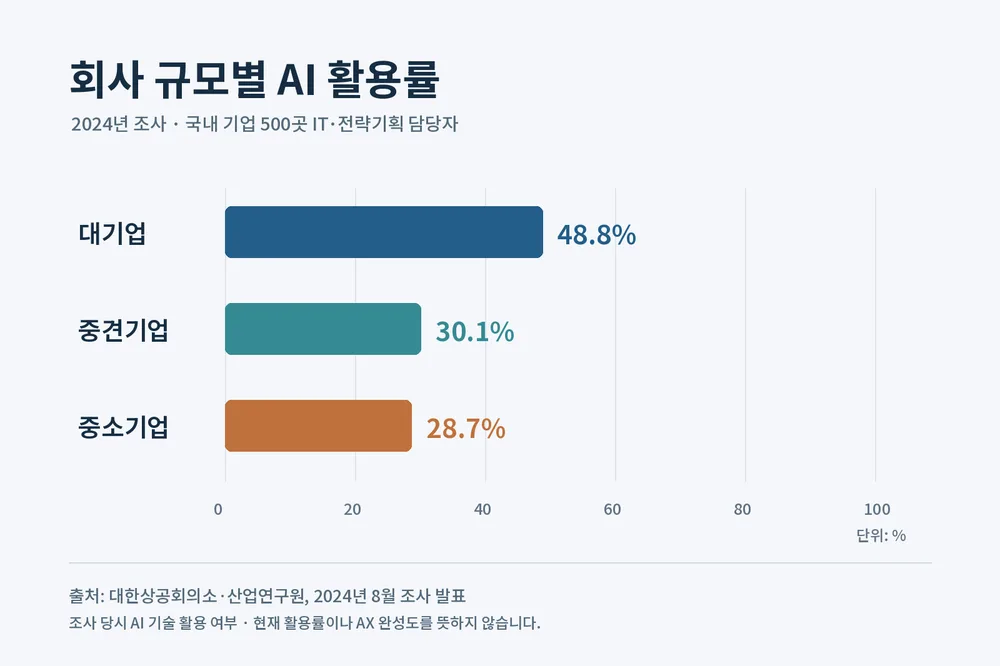
When the Korea Chamber of Commerce and Industry (KCCI) and the Korea Institute for Industrial Economics and Trade surveyed 500 Korean companies in 2024, the share saying they used AI technology was:
| Share using AI technology (2024 survey) | |
|---|---|
| Large companies | 48.8% |
| Mid-sized companies | 30.1% |
| SMEs | 28.7% |
These figures show whether companies used AI at the time of the survey. They don’t show today’s usage rate or how far AX has gone. But they do show that conditions for adoption differed by size.
In June 2026, KCCI’s research institute published another analysis based on a survey of about 3,000 workers. It found that once company support and individual skills are taken into account, the usage gap between large companies and SMEs narrows. One way to read this: look not only at size but at the environment, such as training, usage rules and cost support. Still, it is a survey analysis; it doesn’t guarantee that adding one form of support will produce the same effect.
Large companies: how do you connect scattered use?
If several departments already use AI, how to connect it matters more than what to bring in next. If sales and purchasing organize data by different standards, or employees each put company documents into different AI tools, confusion follows.
- Decide which data and tools may be used
- Connect AI to existing ERP or document systems
- Set standards for checking results
Even when AI reviews contracts, someone has to decide which materials it refers to, who gives final approval and where revision history is kept.
Mid-sized companies: how do you confirm the effect?
When work has grown complex and departments have multiplied but there is no one dedicated to AI, starting with a big system is a burden. It is more realistic to pick one task where the effect can be checked, such as a weekly report or repeated quote reviews, and compare it with the old way.
Only by checking how much drafting time fell, and whether errors or corrections rose, can you decide on the next investment. Even with outside help, someone inside needs to explain the work and check the results.
Small companies: what do you change first?
If one person takes orders, handles shipping and checks unpaid bills, it is better to look at daily repetitive work than at a grand AI strategy. If orders received by messenger and text are copied into a spreadsheet, AI can first sort the items and quantities for an employee to check. When checked orders flow into the shipping list, re-entering the same details drops.
You don’t have to gather all company data into one system first. Decide the format and storage location for the data the task at hand needs; organizing data and small AI use can go together. The more specific the goal, such as “cut the time spent sorting the day’s orders,” the easier it is to start.

What should you look at before size?
Large companies can have scattered data too, and small ones may already have good systems and usage rules. The split above is not a fixed answer by size.
| Where your company is now | What to look at first |
|---|---|
| Already uses AI widely | Connections and standards |
| Unsure of the effect | Small trials and measurement |
| Data is scattered | Organizing the data the task needs |
In the end, the first question should be closer to “What do we keep repeating or missing?” than “Which AI should we buy?”
In short
- AX means bringing AI into work to change how it gets done; what matters is not how often AI is switched on but what changed.
- In a 2024 survey, AI use was 48.8% at large companies, 30.1% at mid-sized companies and 28.7% at SMEs, but these reflect use at the time of the survey.
- One analysis finds the gap narrows when company support and individual skills are considered, so look at training, rules and support as well as size.
- If you already use AI widely, start with connections and standards; if the effect is unclear, with trials and measurement; if data is scattered, with organizing what the task needs.
If you want to check how ready your company is for AX, try the free AX self-check (in Korean).
In the next post, we’ll look separately at AX for medium-sized businesses within SMEs.
Sources (checked 2026-10-26)
- ISSUE ON, SME AI usage rates differ by survey (includes the 2024 KCCI–KIET figures, Oct 2026, Korean)
- Asia Today, KCCI: SME AI gap is about environment, not size (Jun 2026, Korean)
- eToday, SME AI use is low, gap narrows with organizational support (Jun 2026, Korean)
Related reading: How to Ask AI Well · Where Can Your Personal Data Leak from ChatGPT?

A software planner who became a developer after two years of working with AI five to twelve hours a day. Today I build FROX, an AI-powered business system, at ONE-PEX.
More posts
- What Can You Build with AI?Orders in KakaoTalk, Stock in Excel, Receivables in a Notebook: Changing Messenger Orders Only the Owner Understands (Food Supplier, Part 1)
- What Can You Build with AI?I Fixed My TWA App, So Why Didn't It Change? What I Learned from the War with Caching
- What Can You Build with AI?Details Matter: Splitting 3D Characters and Vehicles So They Can Move (Building Road Voca 2, Part 5)