
 Song-saem: From Planner to Developer with AIBlog home →
Orders in KakaoTalk, Stock in Excel, Receivables in a Notebook: Changing Messenger Orders Only the Owner Understands (Food Supplier, Part 1)
At a food supplier, orders arrive every evening by messenger, text and phone, and know-how like "this restaurant's 'peeled garlic' means minced garlic" lives only in the owner's head. Using a fictional company, I show how pasting the original lets AI draft the order, a person confirms it, and checked phrases stay in a per-customer alias dictionary.

What if only the owner can understand the orders that come in by messenger? One approach is to paste the original message as it is, let AI break it into items and draft an order, and have a person check the unclear parts and confirm it. Phrases a person has checked go into a per-customer alias dictionary, so rules that lived only in the owner's head start to build up in the company. The goal isn't for AI to confirm every order on its own, but to cut down on copying and leave time for the orders that need judgment.
Some business owners work from dawn to evening, come home, and open their books again, tired. Sorting out pending orders, stock and money owed takes up the rest of the day. There's little room left to think about what to prepare next or when to buy and sell. Busy with the urgent work, they sometimes miss the moments that matter.
That's why I started building apps for small business owners. I wanted to cut the time spent copying and checking the same things over and over, and give owners time to think about their own business.
At 11 p.m., a regular restaurant's order for tomorrow arrives on the owner's phone. (KakaoTalk is the messenger most Koreans use.)
minced kimchi 1 bean sprouts 2 perilla leaves 2 eggs 5 trays cheongyang chili 1 peeled garlic 1 make the minced kimchi chinese please 3kg
The owner knows at a glance: the eggs are the usual extra-large, and "peeled garlic" is actually what this restaurant calls minced garlic. The second line specifies the origin and size of the minced kimchi.
The problem is that the owner is the only one who knows this. Using a fictional food supplier, "ONE-PEX Food," I'll show how a business system can handle orders like these.
What hides in a single order line
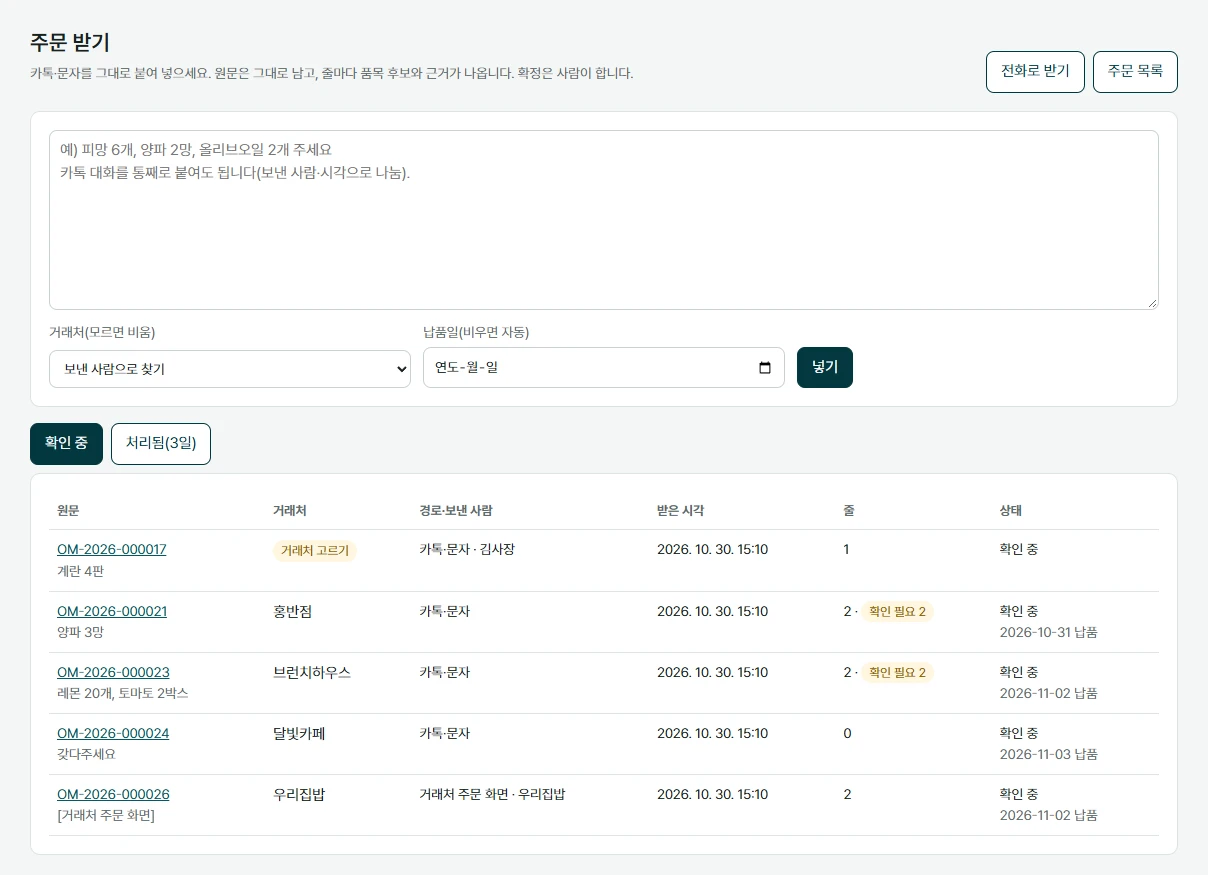
Even "eggs" can mean different things depending on whether they're extra-large or large, and whether they come by the tray or loose. Does "bean sprouts 2" mean two bags or 2 kg? Each customer uses different wording, and prices can differ too.
With 30 customers, dozens of orders like these can arrive every evening, by messenger, text and phone. The next morning, someone copies them one by one into Excel or an order form.
When people change, so does the interpretation
What's harder than copying is that the rules for interpreting orders live only in people's heads.
A long-time employee knows "when this restaurant says peeled garlic, it means minced garlic." A new employee doesn't. Send peeled garlic as written, and a return and a phone call may follow. This is one reason the owner finds it hard to take even a day off.
So simply copying the words isn't enough. Each customer's wording and ordering habits need to stay in the company too.
Paste the original, and it becomes an order to check
In the ONE-PEX Food demo, staff paste the order received by messenger as it is. AI breaks it into items and drafts an order based on the products registered in the system and each customer's rules.

- The original is kept as is. The interpreted order and the original are stored side by side, so if someone later says the contents were different, you can compare them.
- Items, quantities and units are split out and linked to prices. If a customer alias or a registered rule was used, the reasoning is shown too.
- Corrections added later are caught. A line like "make the minced kimchi Chinese please 3kg," which specifies or changes an earlier item, is linked to that item.
- Unclear parts are left for checking. Nothing uncertain is confirmed on its own; a person makes the final check.
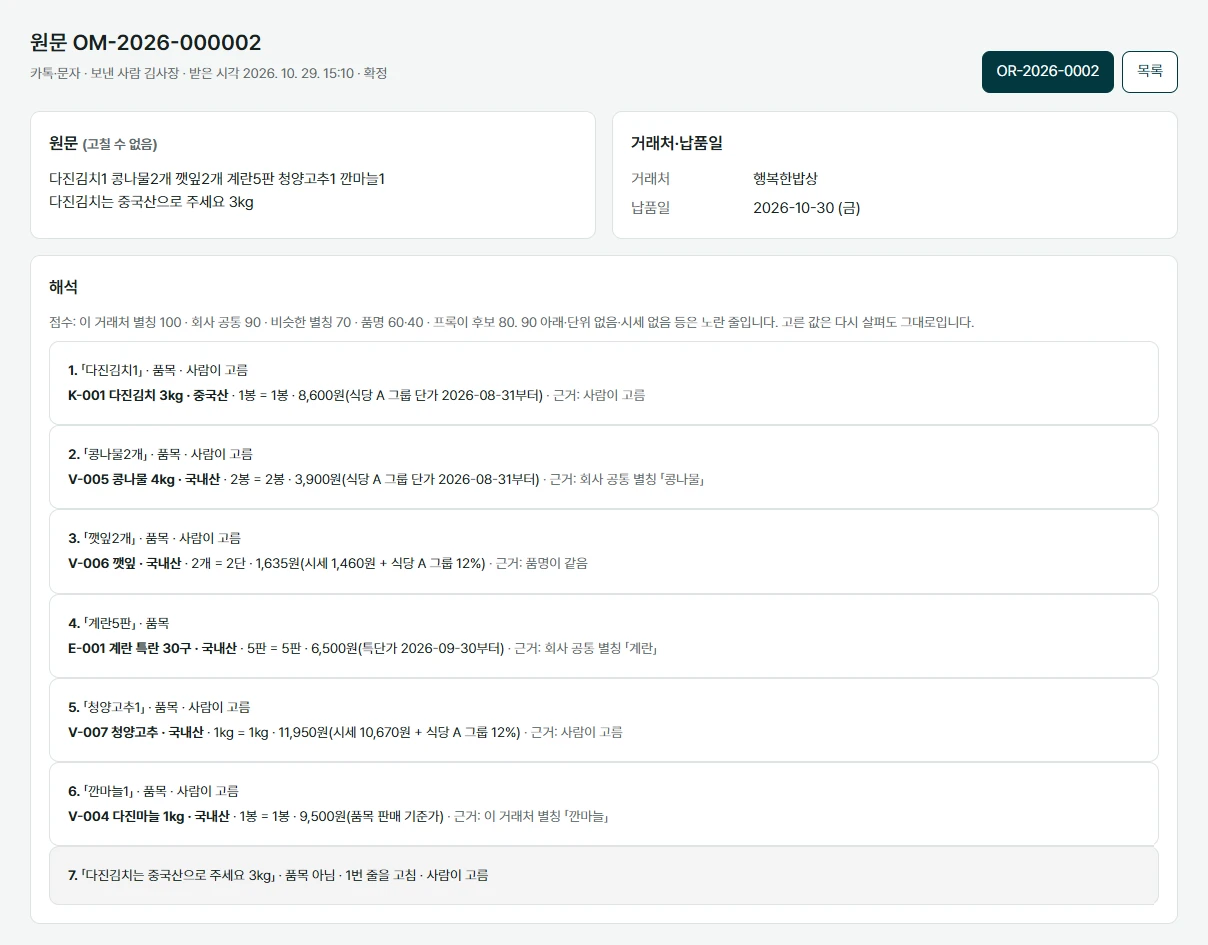
What matters here is that it doesn't end with AI reading well once.
Phrases a person has checked can be registered in that customer's alias dictionary. The next order refers to those rules, so there's less need to explain the same thing from scratch every time. Still, a customer may order something unusual, so the original and the reasoning should always stay visible.
This is how rules that lived only in the owner's head start to stay in the company.
Where the morning changes
Once orders are sorted out and confirmed by a person, the next tasks can pick up the same data: what to prepare for tomorrow and how much, what goes on which truck, and what goes on the invoice.
What the owner looks at first in the morning changes too. Instead of rereading every message that came in overnight, they see confirmed orders, orders still needing a check, and orders received after the cutoff, separately.
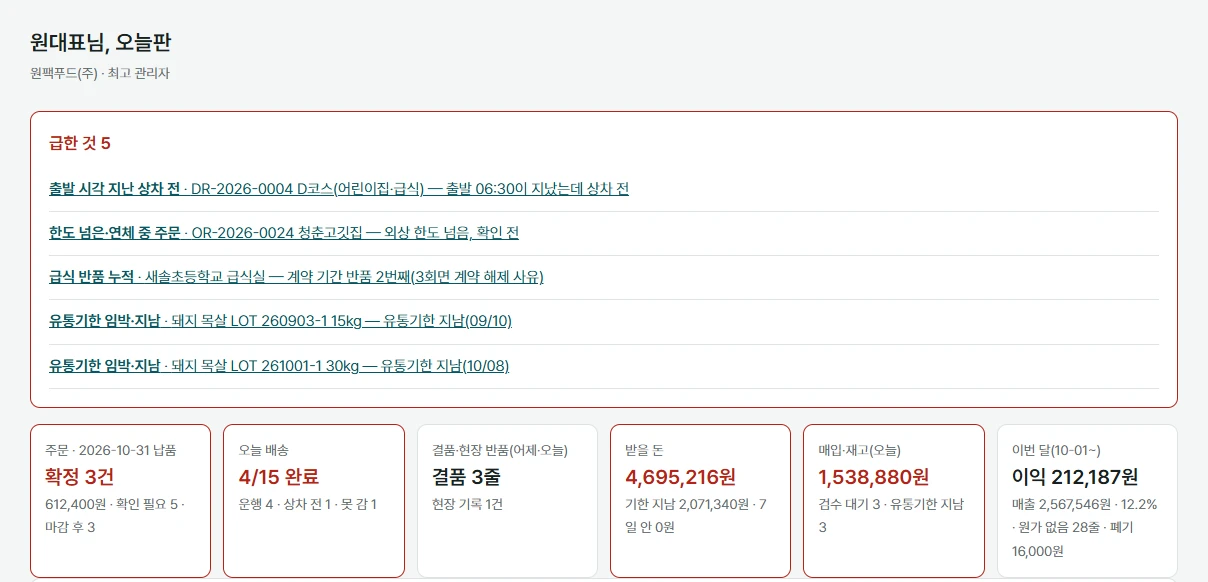
The goal isn't for AI to confirm every order on its own. It's to cut down on the copying people do over and over, and let them spend time on the orders that need judgment.
In the next part, I'll follow how these confirmed orders carry through to early-morning loading, morning delivery and even returns.
In short
- A food supplier's messenger orders vary by customer, so the rules for reading them tend to live only in the owner's head.
- Paste the original, and AI splits it into items, quantities and units and drafts an order with its reasoning.
- Unclear parts are left for checking, and a person confirms the order.
- Checked phrases stay in a per-customer alias dictionary, so what only the owner knew builds up in the company.
FROX, the business system I build at ONE-PEX, aims for the same: not removing people's judgment, but cutting repetitive work and helping that judgment stay in the company.
*All companies, customers, orders and numbers in this post are fictional demo data.*

A software planner who became a developer after two years of working with AI five to twelve hours a day. Today I build FROX, an AI-powered business system, at ONE-PEX.
More posts
- What Can You Build with AI?I Fixed My TWA App, So Why Didn't It Change? What I Learned from the War with Caching
- What Can You Build with AI?Details Matter: Splitting 3D Characters and Vehicles So They Can Move (Building Road Voca 2, Part 5)
- What Can You Build with AI?Do Korean Stocks Rise When US Biotech Stocks Do? I Measured, It Was Different, and What It Costs (Building a Stock App, Part 3)