
 Song-saem: From Planner to Developer with AIBlog home →
Where Should Small Businesses and Shops Start with AX? With One Task the Owner Does Every Day
In a small shop or office where the owner handles orders, payments and inquiries alike, start by asking what you want to cut rather than what AI can do. Pick one nearby task, such as sorting orders, checking payments, a weekly summary or stock, let AI organize and draft, and keep checking and deciding with the owner.

Where should small businesses and micro-enterprises start with AX? Where the owner takes orders, checks payments and answers customers, it is better to start by asking which current task you want to cut than what AI can do. There is no need to automate everything from the start: you can begin by letting AI organize and draft while the owner checks. In the Ministry of SMEs and Startups’ statistics for 2024, Korea had about 8.11 million micro-enterprises. AI transformation only becomes realistic if it works where there is no one who specializes in AI.
What counts as a micro-enterprise?
Micro-enterprises are not only restaurants and neighborhood shops. Small suppliers, repair businesses, wholesalers and retailers, and offices can also qualify depending on industry and size criteria; it is not decided by headcount alone but together with the small-business criteria.
| Category (2024) | Companies |
|---|---|
| All SMEs | 8,499,552 |
| Micro-enterprises | 8,109,650 |
Source: Ministry of SMEs and Startups, basic SME statistics for 2024 (released August 2026)
How do you cut re-copying orders?
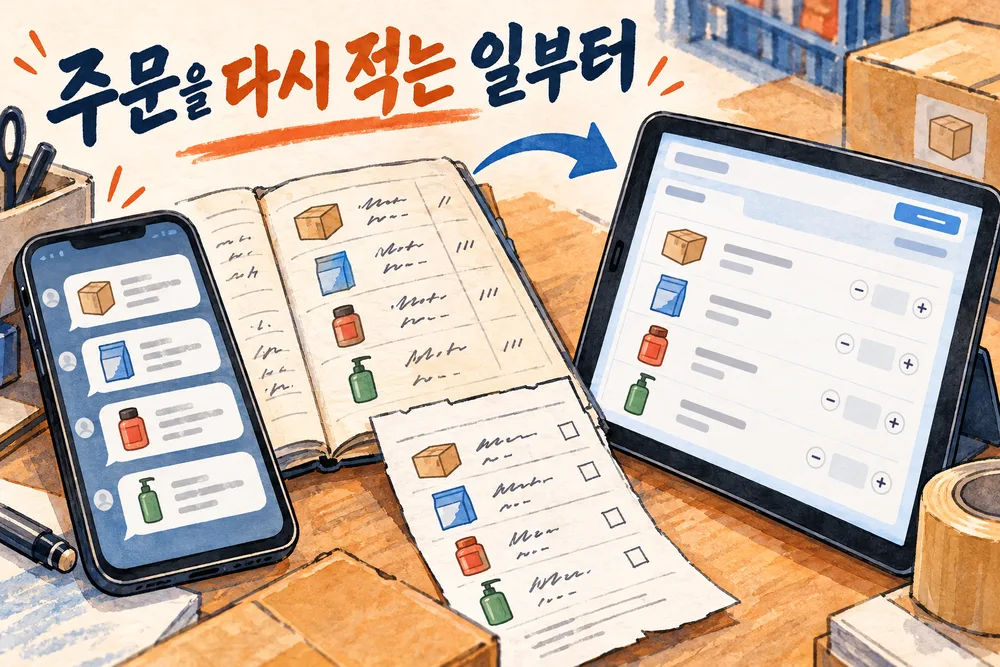
Say an order arrives by messenger: “Two more boxes of the bags we got last time, please.” Someone reads it, works out the item and copies it onto the order form, again and again.
AI can sort the order into item, quantity and delivery date. But if there is nothing to tell it which “bags from last time” those are, it should ask rather than fill the gap on its own. A person checks the draft and adds it to the order form or shipping list. Even if you copy and paste at first, once the effect shows over repeated use, you can connect it to your business software later.
How can it help with payments, weekly summaries and stock?
| Task | What to give AI | What the owner checks |
|---|---|---|
| Unpaid bills | Find overdue transactions in the books and draft reminder messages | The books may be updated late or the payer’s name may differ, so compare with recent deposits before sending |
| Weekly summary | Summarize sales, spending and next week’s schedule on one page, noting changes and things to check | Verify totals against the raw data or a calculator |
| Stock | Suggest order quantities from sales records and current stock | Tell it what it doesn’t know, such as delivery lead times or upcoming events, and confirm the final quantity |
If AI drafts, who decides?
Anthropic’s small-business plugin (part of its public knowledge-work-plugins) follows this principle too. It covers 44 tasks across money, sales, marketing and operations, and it has actions such as sending, posting and paying happen only after the user approves.
Connecting it to the bookkeeping and software used in Korea may need separate checks and setup. Still, the way it divides the work is worth borrowing: AI organizes the data and drafts, and a person checks that it matches reality before acting.
Writing this principle down is also different from making a program actually ask for approval. When you connect tools, check permissions and approval settings as well.

How should you ask at first?
Prepare sample orders with sensitive details removed and ask something like:
“Sort the orders below into item, quantity and delivery date. Don’t guess anything that isn’t written; mark it ‘needs checking.’ Put unclear items like ‘the same as last time’ in a separate list, and write the questions I should ask the customer.”
You don’t need to feed it all your real customer data from the start. Check with a few dummy orders whether you get the result you want. If it works, widen the scope to the minimum data real work needs; to tell customers apart, you can use something like account codes instead of names.
What should you pick, and how long should you try it?
Pick just one of these to start: sorting orders, checking payments, a weekly summary or answering inquiries. The one you do most often, or the one that costs money when missed, is a good choice. While using it for a few days, look at three simple things:
- Did it save time?
- Did you miss fewer things?
- Did fixing what AI made take more work?
It has only helped if things got easier including the time spent checking. There is no need to buy expensive equipment or pay for several AI services at once: confirm a small effect with the tools you have, then add the features and connections you need.

What should you check about support programs?
In 2026, programs such as AI support for innovative micro-enterprises, smart store technology and the AI voucher were announced. But programs that support training and planning differ from those that support buying equipment and software. Limits and the owner’s share differ by type, and some calls have already closed.
Check current openings and coverage on Sosanggongin24, the official smart store notices and Bizinfo (기업마당). Writing down what you need first, such as “we want to stop re-entering orders,” makes it easier to judge which support fits.
In short
- AX for small shops and offices starts with what you want to cut, not with what AI can do.
- Let AI organize and draft nearby tasks such as orders, unpaid bills, weekly summaries and stock, while the owner checks and decides.
- Have AI mark what it doesn’t know as “needs checking” instead of guessing, and test with dummy data first.
- Pick one task, use it for a few days, and see whether it got easier including checking time.
- Decide what you need before checking support programs’ conditions and deadlines.
If you want to check how ready your company is for AX, try the free AX self-check (in Korean).
In the next post, regardless of company size, we’ll sort out which work to hand to AI and which people should keep judging.
Sources (checked 2026-10-26)
- Ministry of SMEs and Startups, basic SME statistics for 2024 (Aug 2026, Korean PDF)
- Statistics Korea index, definition of micro-enterprises (Korean)
- Anthropic, knowledge-work-plugins repository (small-business)
- Herald Economy, AI support for innovative micro-enterprises (May 2026, Korean)
- MTN, 2026 smart store technology for micro-enterprises (Aug 2026, Korean)
Related reading: Where Should a Medium-sized Business Start with AX? · What Is AX? AI Transformation Is Not the Same for Large, Mid-sized and Small Companies

A software planner who became a developer after two years of working with AI five to twelve hours a day. Today I build FROX, an AI-powered business system, at ONE-PEX.
More posts
- What Can You Build with AI?Orders in KakaoTalk, Stock in Excel, Receivables in a Notebook: Changing Messenger Orders Only the Owner Understands (Food Supplier, Part 1)
- What Can You Build with AI?I Fixed My TWA App, So Why Didn't It Change? What I Learned from the War with Caching
- What Can You Build with AI?Details Matter: Splitting 3D Characters and Vehicles So They Can Move (Building Road Voca 2, Part 5)