
 Song-saem: From Planner to Developer with AIBlog home →
Where Should a Medium-sized Business Start with AX? With the Records It Already Has and One Task
In Korea, a medium-sized business is a category within SMEs, distinct from mid-market companies. If departments are separate and records pile up in ERP, production systems and spreadsheets, start with the data you already have, pick one task, record the numbers before you begin, and test small. With cases, a first prompt and how to check support programs.

Where should a medium-sized business start with AX? If a company has separate departments and work records piling up in ERP, production systems or spreadsheets, the starting point is to look at the data it already has before looking for new AI. Then pick one task that repeats and whose results can be checked, record the numbers before you start, test small, and connect it to real work. In the Ministry of SMEs and Startups’ statistics for 2024, Korea had about 8.5 million SMEs, of which about 143,000 were medium-sized businesses. “SME support” covers companies of very different sizes and ways of working.
How is a medium-sized business different from a mid-market company?
The names sound alike, but in Korea they are different categories. A medium-sized business is an SME that is not a small business; the split is based not simply on headcount but on criteria such as sales by industry. A mid-market company is one that has outgrown the SME criteria altogether.
| Category (2024) | Companies |
|---|---|
| All SMEs | 8,499,552 |
| Micro-enterprises | 8,109,650 |
| Small businesses other than micro | 246,724 |
| Medium-sized businesses | 143,178 |
Source: Ministry of SMEs and Startups, basic SME statistics for 2024 (released August 2026)
What should you look at before looking for new AI?
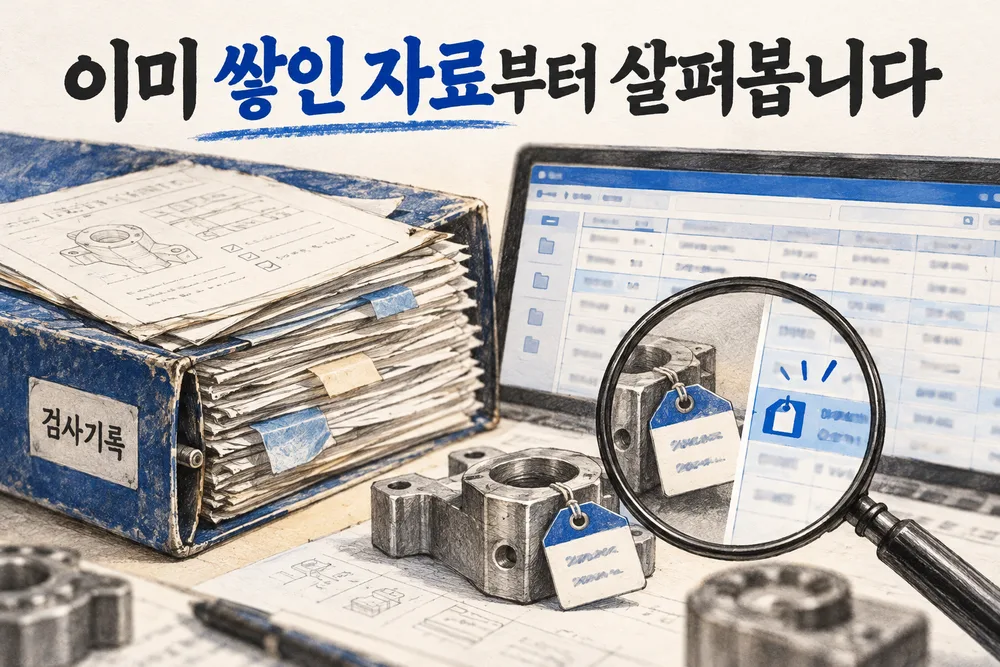
Companies hold more records than you might think: inspection results, defect causes, equipment checks, quotes, customer inquiries. The problem is that having records and being able to use them are different things.
If departments name the same product differently, or defect causes are written freely, the data is hard to connect. Before attaching AI, align the fields and standards the task at hand needs.
You don’t need to organize all company data at once. To improve quality inspection, start with that product’s inspection records; to cut quote writing, start with past quotes and item information.
Where did real cases attach AI?
Hankyung’s coverage of SME AX best practices introduced these cases:
| Company | Where AI was attached | Reported result |
|---|---|---|
| CDRI (cosmetics) | Reviewing full ingredient lists on export cosmetics labels | Inspection 2.54 times faster, error rate improved |
| WSG (steel tubes) | Predicting and adjusting current in electropolishing | Lower nonconformity rate |
What to notice is less the numbers than where AI was attached: the problems, label review and one process, were specific. Such cases don’t guarantee the same results everywhere, but they help in choosing a starting point. Outside manufacturing, that spot could be repetitive document work such as checking required items in contracts, drafting quotes or sorting customer inquiries.

Which task do you pick, and what do you record?
Start with work that repeats often, where mistakes are costly and results can be checked. “Cut the time spent organizing inspection records” is easier to test than “raise company productivity.”
| What to decide | Example |
|---|---|
| One task to change | Organizing inspection records, drafting quotes, sorting inquiries |
| Numbers before you start | Time per item, number of corrections or rework |
| Review standards and owner | What AI checks, when it hands off to a person, who makes the final call |
| Where AI ends and ordinary software begins | Simple totals and fixed calculations stay in existing software |
You need the before-numbers to judge later whether things improved. Deciding which parts need AI and which ordinary software can handle is also part of the design.
How do you test small and then expand?
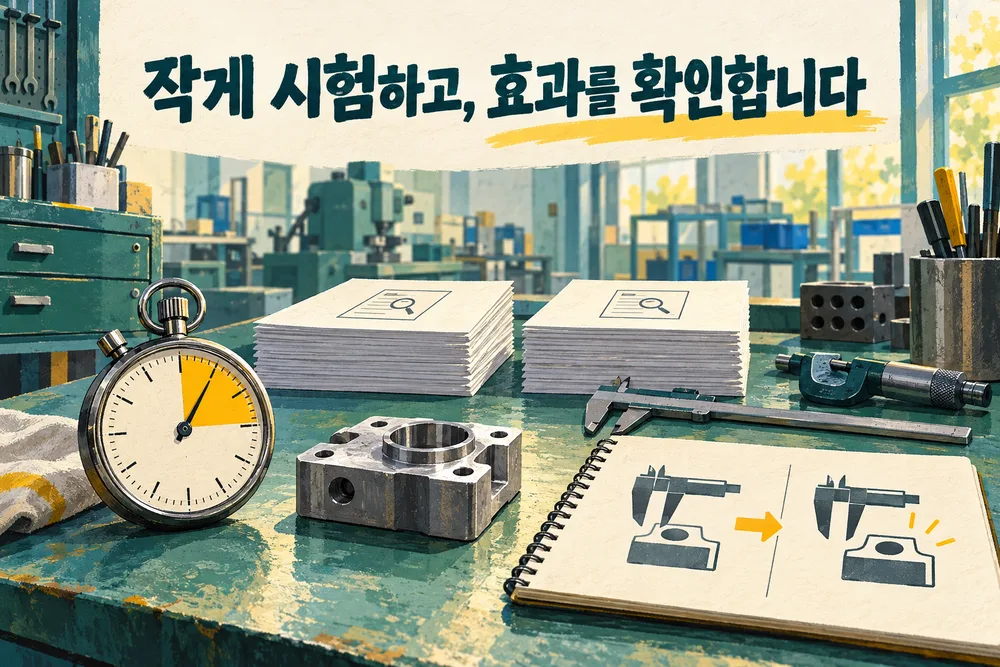
Rather than letting AI adjust equipment or send documents to customers from day one, compare results on past data first. Have the person in charge check the problems AI found, and record what it missed and what it flagged wrongly.
Then apply it to a limited part of real work. If processing time fell but checking work grew, it still needs improvement; count the time people spend reviewing and fixing, not just AI’s working time. Decide at this stage how much company data to use, which AI to connect and how to keep change records.
How might you ask AI for the first time?
Prepare data with sensitive information removed, or dummy data, and ask something like:
“Look at the fields in our inspection records and suggest three tasks AI could help with. For each, list the data needed, the parts a person should check, and the metrics to compare before and after. If the data isn’t enough, ask me first instead of guessing.”
The point is to have AI explain what is possible and what is missing before it decides on a solution.
When should you check support programs?
There are programs that support adoption, such as the AI voucher, the AX one-stop voucher and smart-factory programs. But each differs in who qualifies, what it covers, the company’s own share and when to apply, and a program’s total budget is not what your company will receive.
Some 2026 calls have already closed. Check current openings and your eligibility in notices from NIPA, Bizinfo (기업마당) and smart-factory programs. Before looking for support, decide which task you will change, why, and how you will check the effect; then you can judge vendors’ proposals by your own standards.
In short
- A medium-sized business is an SME that is not a small business, a different category from a mid-market company.
- Before looking for new AI, look at the records you already have and align the fields and standards the task needs.
- Pick one task that repeats and can be checked, record the before-numbers, and set review standards and an owner.
- Test on past data first, judge the effect including people’s review time, then connect it to real work.
- Look at support programs after setting the goal, checking eligibility and scope in current notices.
If you want to check how ready your company is for AX, try the free AX self-check (in Korean).
In the next post, we’ll look at AX for small businesses and micro-enterprises with only a few employees.
Sources (checked 2026-10-26)
- Ministry of SMEs and Startups, basic SME statistics for 2024 (Aug 2026, Korean PDF)
- Hankyung, SME AX best practices and regional AI programs (Dec 2025, Korean)
- Electronic Times, 2026 AI, AX one-stop, data and cloud vouchers (Mar 2026, Korean)
Related reading: What Is AX? AI Transformation Is Not the Same for Large, Mid-sized and Small Companies · How to Ask AI Well

A software planner who became a developer after two years of working with AI five to twelve hours a day. Today I build FROX, an AI-powered business system, at ONE-PEX.
More posts
- What Can You Build with AI?Orders in KakaoTalk, Stock in Excel, Receivables in a Notebook: Changing Messenger Orders Only the Owner Understands (Food Supplier, Part 1)
- What Can You Build with AI?I Fixed My TWA App, So Why Didn't It Change? What I Learned from the War with Caching
- What Can You Build with AI?Details Matter: Splitting 3D Characters and Vehicles So They Can Move (Building Road Voca 2, Part 5)