
 Song-saem: From Planner to Developer with AIBlog home →
Does AX Need Employee Training? A System That Works Comes Before How-To Training
When starting AX, it’s easy to think of AI training for staff first, but how-to skills one person learns rarely stay as the company’s way of working. A structure where people get AI’s help inside everyday work comes first. Set rules for checking results and handling data, then let people learn by practicing their real work.
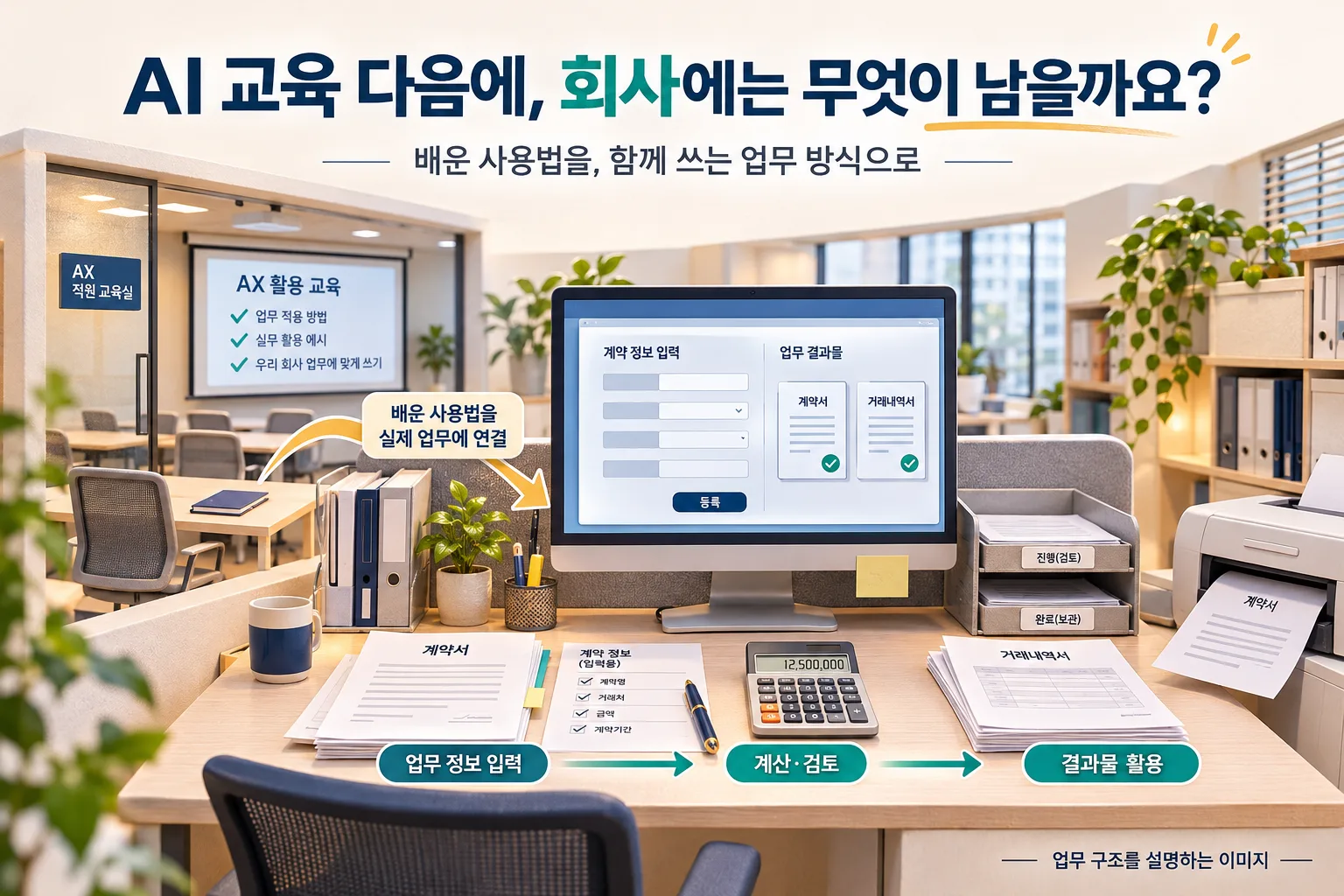
Does AX need employee training? Yes, but training that only teaches how to use AI isn’t enough. What one person learns only stays with the company once it becomes a shared way of working, and that needs a structure where people get help while doing their everyday work. I think training should first settle what results are checked against and who checks them, and which data may be handled where, and then let people learn the rest by practicing their real work.
When AX comes up, people often say, “First we need to train our staff in AI”: how to use ChatGPT, how to write prompts.
It’s a good thing when trained employees get better at their work. But a company has to ask one more question: “Will what that employee learned also stay as our company’s way of working?”
One person’s AI skill isn’t enough
An employee who uses AI well can organize writing quickly and produce the materials they need with ease. But if that method stays only as personal know-how, other staff can’t get the same help. And when that person is away or replaced, the work is hard to carry on.
To turn what individuals learn into a company capability, it has to move into shared procedures and checking standards. Whoever takes over should be able to find the information they need, handle it in a set order and check the parts that matter.

I want to avoid a setup where you must be good at AI to get work done
This is also what I focus on when I build business systems. Rather than a setup where each employee has to write good prompts to get results, I think it’s better to have a structure where people get the help they need while doing their everyday work.
For example, entering a contract leads into the set calculations and documents, and the screen shows what’s missing and what to do next.
Here, the calculations and required-field checks are handled by fixed rules, and AI can take on tasks like organizing explanations or drafting. Not every feature needs AI, either. What matters is whether it becomes easier for staff to finish their own work.
Still, two things should be settled first
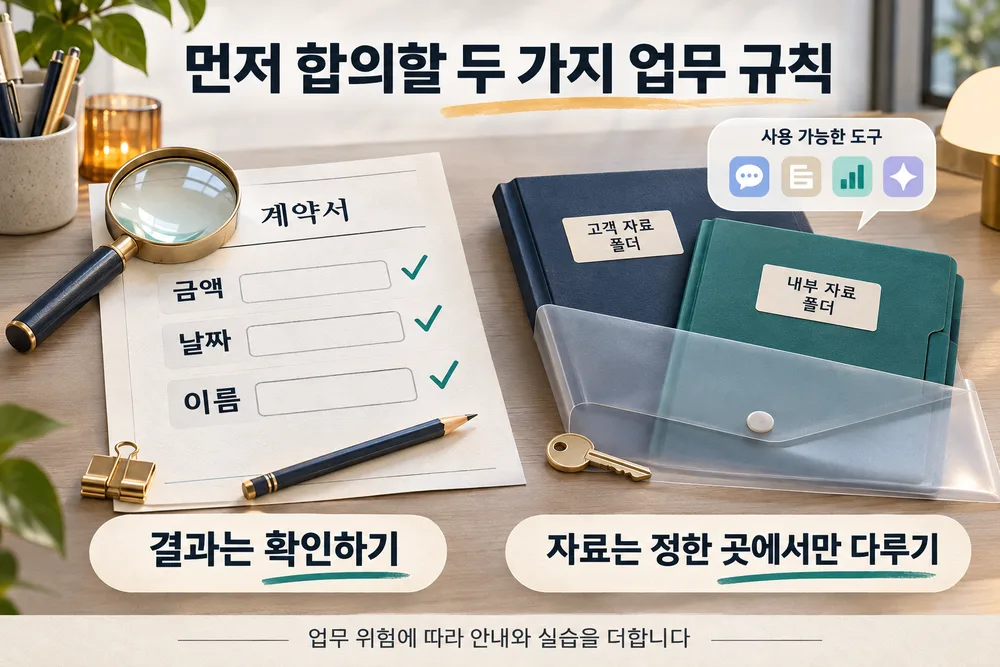
That doesn’t mean training is unnecessary. Even when the tools are easy, some principles remain that staff need to know. I think at least these two should be settled first.
- What results are checked against, and who checks them: AI-made content can look convincing and still be wrong. Important details like amounts, dates and names should be checked against the source, and it should be clear who does the final check. Specific items to check work better than just saying “check carefully.”
- Which data may be handled where: which tools customer information and internal files may go into shouldn’t be left to each employee’s judgment alone. It’s better to set the tools that may be used, the scope of data, and the person to ask when in doubt.
For simple tasks, a short briefing and some practice are a fine start. But for work involving sensitive data or important decisions, training and checks suited to it should be added.
Even for large companies, the starting point is real work
The bigger the company, the more varied the roles and tasks, so the training needed differs too. Teaching every employee the same how-to rarely changes each person’s work.
I think it’s more realistic to have contract staff learn through contract work and customer-service staff through customer work. Along with which tools to use, you show what has changed from before and where they need to judge and check.
Changing the organization and the system together needs a small test
Some companies will use AX as a chance to change roles and ways of working in a big way. Depending on the company, that may be the right choice.
But I think it calls for care to roll out an untested way of working and a new system across the whole company at the same time. When problems appear, it becomes hard to tell whether the roles and procedures don’t fit or the system was built wrong.
I don’t mean the organization and the system should be thought of separately. Design them together, but run them first in some tasks or a small team, then widen from there.
Practicing real work becomes the training
That’s why I put weight on simulation before go-live: working through everyday tasks from start to finish with practice data.
You enter a contract, compare the calculations and documents, and also handle what happens when there’s a change or a cancellation. It shows where things get stuck, where explanations are missing and who needs to check what.
Staff get used to the screens, and the people building the system find what to fix. How-to training and system checking happen in the same process.

One client I worked with also set aside a period before go-live to run the old way and the new system side by side. Staff learned the new screens through their own work, and the parts that didn’t fit could be fixed before launch.
Training has to stay as the company’s way of working
I think what matters is not the fact that AX training was held, but how the work changed afterward.
I want to build a structure where staff get the help they need without recalling AI how-tos every time, important results are checked against set standards, and work carries on even when the person in charge changes.
Training belongs inside that structure too: state the shared principles clearly, practice with each person’s own work, and fix what actually gets stuck. That’s where AX employee training starts, as I see it.
Related reading: What Is AX? It’s Not the Same for Large, Mid-Sized and Small Companies · Where Should a Medium-Sized Business Start with AX? · Why Is AI So Confidently Wrong?

A software planner who became a developer after two years of working with AI five to twelve hours a day. Today I build FROX, an AI-powered business system, at ONE-PEX.
More posts
- What Can You Build with AI?Orders in KakaoTalk, Stock in Excel, Receivables in a Notebook: Changing Messenger Orders Only the Owner Understands (Food Supplier, Part 1)
- What Can You Build with AI?I Fixed My TWA App, So Why Didn't It Change? What I Learned from the War with Caching
- What Can You Build with AI?Details Matter: Splitting 3D Characters and Vehicles So They Can Move (Building Road Voca 2, Part 5)