
 Song-saem: From Planner to Developer with AIBlog home →
Why I’m Remaking My Word Game After 25 Years of Teaching English (Building Road Voca 2, Part 1)
Over 25 years of teaching English, I kept looking for ways to help students understand words and review them steadily. That led to my word-roots book Ttaraga! Voca and to Road Voca, my first vibe-coding project. Now I’m building Road Voca 2, a game where playing itself becomes study. This is the first entry in that making-of log.

Why remake Road Voca? The first Road Voca was a study tool for reviewing words from my roots book Ttaraga! Voca, with a few game elements added. Since then, AI coding tools have advanced quickly and I’ve built up experience making things, so this time I’m trying again with a game where players meet words and recall them as they play. This first entry traces how a question that began with a book turned into a game.
I didn’t want it to stop at memorizing one meaning
I taught English for about 25 years. One thing that always saddened me was seeing students still memorize words the way I did 40 years ago: English words and Korean meanings written side by side, covering one column while you memorize the other.
Remembering words matters. But if you link each English word to just one Korean meaning, you can misread it when it’s used in a different sense in a sentence. You know the word, yet the sentence comes out wrong.
I wanted students to look at why a word came to mean what it does, and which parts it shares with other words. So for the past 15 years I’ve taught vocabulary through word roots, and I gathered that experience into a book I wrote and sold, Ttaraga! Voca.
Studying by following the path a word was built on
Ttaraga! Voca groups prefixes that mean “together,” such as co, com, con, col and cor. Students first see that the same meaning shows up in slightly different forms from word to word.
I also added memory pictures to help the meaning stick. A koala and a computer sitting “together” is a memory hook for the prefix. Students remember the meaning through the picture, then see how it works in real words.
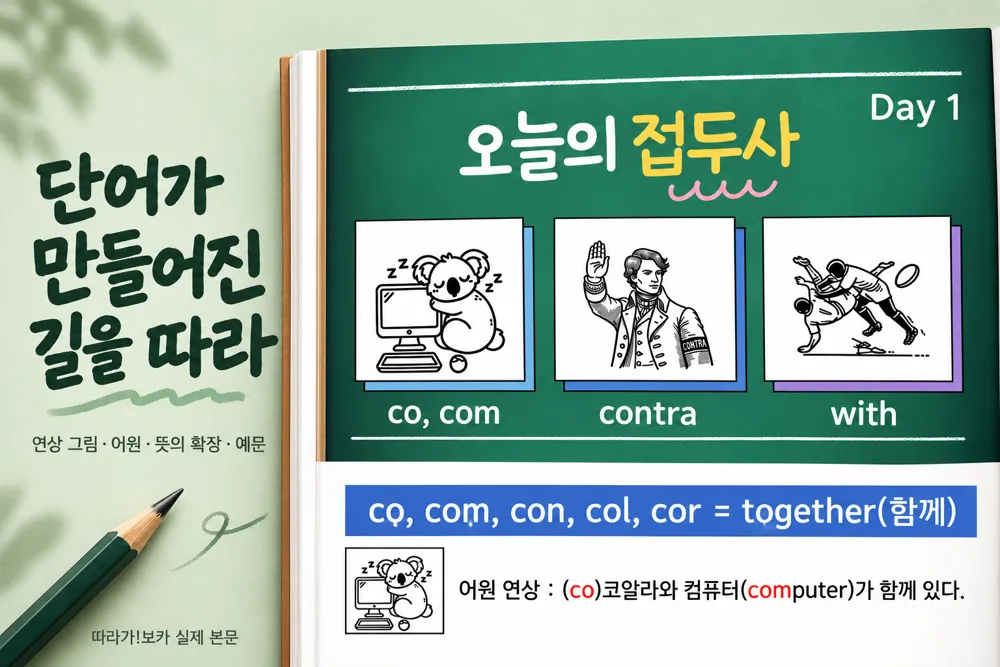
Beyond the prefixes, the book shows how a word’s meaning expands, with example sentences, derived words, synonyms and antonyms. I wanted students to go a step beyond memorizing words one by one and understand them as connected.
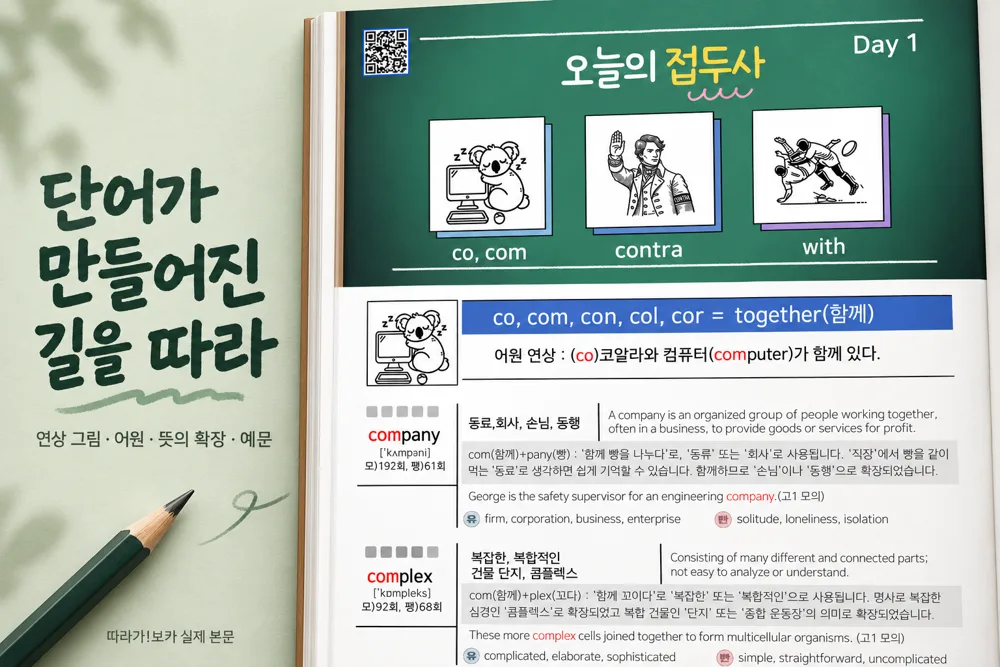
Of course, a meaning guessed from roots still has to be checked against context and real usage. What I wanted wasn’t study without memorizing, but study that adds clues for understanding and remembering.
Words learned in the book, met again in a game
Even words you understood from a book fade if you never meet them again. So I wanted a tool for reviewing outside the book.
That became Road Voca, my first vibe-coding project. I built it by describing to AI what I wanted, and released it as an app on Google Play.
At first I used Unity, a game development tool. AI wrote the code, I put it into the Unity folders, and I learned how to use Unity one step at a time. AI had its limits back then, and I had little experience making games. So the first Road Voca put learning at the center, with a few game elements added.

On the Road Voca 1 study screen, a word is split like pro+vis+ion, and players choose the meaning of pro. It brings back on screen the word parts and affix meanings studied in the book. I also added a car and a road in the background, to give reviewing at least a little of the feel of a game.
A first try at making study fun
Road Voca 1 also had a map for following the study stages, with Day signposts along a coastal road. Rather than showing lessons as a plain list, I wanted it to feel like meeting them along a road.

Reviewing what students learned in the book was the core, and cars and a map were a first attempt at adding fun.
This time, playing the game is the study
Since then, AI coding tools have advanced quickly. I’ve also gained experience building an English-learning website and business systems. Compared with when I made the first Road Voca, I’m now more used to describing what I want in detail, breaking the work into parts and checking the results.
| Road Voca 1 | Road Voca 2 (in progress) | |
|---|---|---|
| Focus | Reviewing words learned in the book | Meeting and recalling words while playing |
| Game elements | Car, road background, study map | Making the gameplay itself the study |
| How it was built | Unity, placing AI-written code by hand | More advanced AI coding tools and accumulated experience |
If the first time I added a few game elements to a study tool, this time I want players to meet words and recall them as they play. Not an app you open briefly because you have to study, but a word game you come back to because it’s fun. That’s the goal of Road Voca 2.
It’s still in progress, so some things won’t work as planned and will need fixing. I’ll show you, one step at a time, what I keep, what I change, and how far I’ve gotten with AI. You can find the current Road Voca on the Road Voca website (one-pex.com).
In short
- In 25 years of teaching English, it saddened me to see students pair each word with one meaning and memorize.
- For 15 years I’ve taught vocabulary through word roots, and gathered that experience into my roots book Ttaraga! Voca.
- To review words from the book, I built Road Voca in Unity as my first vibe-coding project and released it on Google Play.
- I’m now remaking it as Road Voca 2, aiming for a word game where playing is the study.
The experience I’ve gained building the business system FROX at ONE-PEX is carrying over into Road Voca 2.
Next (Part 2): How I’m planning Road Voca 2 with AI.
Related reading: Want to Get Good at AI? Stop Studying It and Build Something

A software planner who became a developer after two years of working with AI five to twelve hours a day. Today I build FROX, an AI-powered business system, at ONE-PEX.
More posts
- What Can You Build with AI?Orders in KakaoTalk, Stock in Excel, Receivables in a Notebook: Changing Messenger Orders Only the Owner Understands (Food Supplier, Part 1)
- What Can You Build with AI?I Fixed My TWA App, So Why Didn't It Change? What I Learned from the War with Caching
- What Can You Build with AI?Details Matter: Splitting 3D Characters and Vehicles So They Can Move (Building Road Voca 2, Part 5)